

Dust deposition effect on wetland invertebrate communities in Iceland. Implications for wetland restoration
Piia Tomingas, doktorsnemi við Landbúnaðarháskóla Íslands.
Rannsókn á hvernig rykákoma (þ.e. vindborið steinefnaryk), ásamt framræslu og endurheimt votlendis, mótar vatnalíf/hryggleysingjasamfélög í votlendi á Suðurlandi.
Nú er markvisst unnið að endurheimt til að snúa við tapi á líffræðilegri fjölbreytni og mikilli losun gróðurhúsalofttegunda sem framræslan hefur valdið. Jafnframt eru íslensk votlendi sérstök að því leyti að þau eru steinefnarík (minerótrofísk), þar sem þau fá stöðugt ákomu af steinefnaríku fokryki frá okkar sérstaka eldgosajarðvegi. Verkefnið snýst um að kanna og öðlast betri skilning á hvernig samverkandi áhrif rykákomu og breytinga á landnotkun móta samfélög hryggleysingja og þar með vistkerfisins í heild og mikilvægi hennar fyrir endurheimt votlendis. Einnig er stefnt að því að bæta aðferðir til árangursríkrar vöktunar á endurheimt votlendis með notkun umhverfis-DNA eða e-DNA.
Wetlands are highly impactful and diverse ecosystems, which have been subjected to intensive drainage over the past century. This has lead to the loss of biodiversity and increasing greenhouse gas emissions worldwide, including Iceland. Icelandic wetlands are known to be uniquely minerotrophic since they receive a constant load of windblown mineral dust, arising mostly from eroding Andosols and extensive barren areas. Only recently have the growing dust deposition effects on ecosystems been acknowledged on a larger scale, especially in the Arctics. The majority of the dust impact studies in wetlands have shown significant changes in soil properties, as well as in vegetation patterns and bird abundances across the dust deposition gradient. A crucial link in wetland ecosystems – invertebrates – is yet understudied and deserves attention due to its significant contribution to biodiversity, food webs, and core ecosystem functions.
To better understand the effect of dust deposition on wetland biota and its implications for wetland restoration, I am conducting a doctoral research project in South and West Iceland. In this sub-project, I aim to find out the following:
(1) how different levels of dust deposition affect wetland invertebrate communities;
(2) how the combined effect of dust deposition and land-use changes, i.e. wetland drainage and restoration, can shape invertebrate communities;
(3) how to effectively monitor wetland restoration sites for improved biodiversity recovery.
My findings will help us predict the future consequences of growing atmospheric aeolian dust amounts on biodiversity in the Arctics and support biodiversity-oriented wetland restoration actions in Iceland.
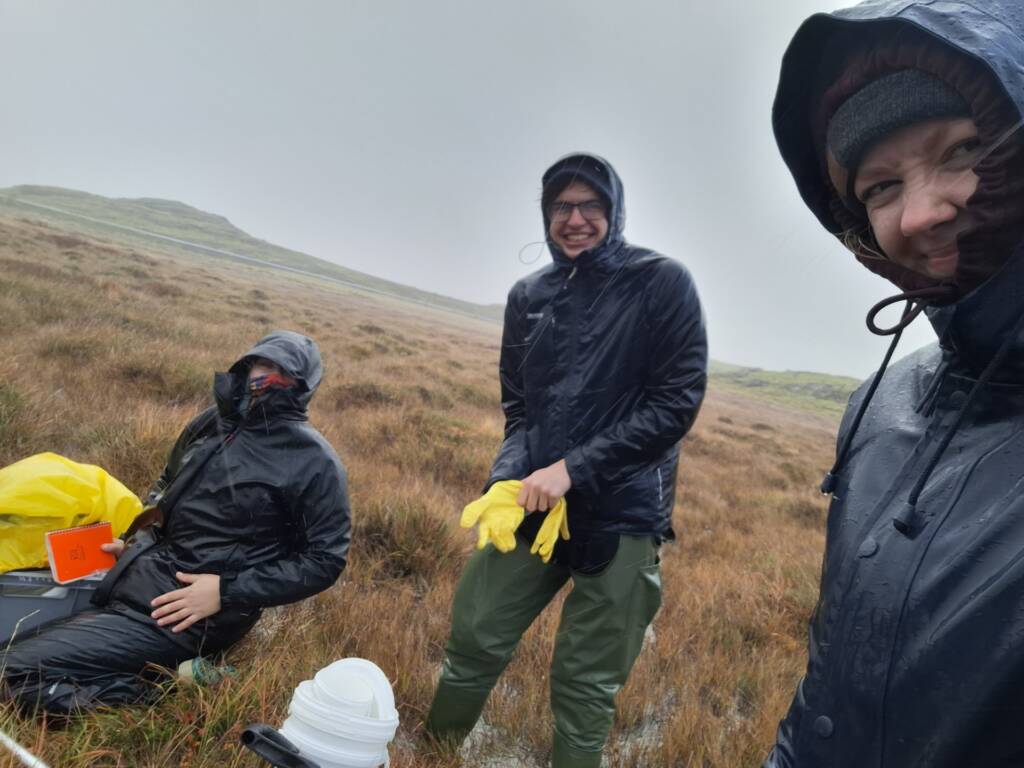
The described work package of the PhD project was launched in autumn 2025 and is expected to be finished in autumn 2027. The first fieldwork for aquatic invertebrate sampling took place in autumn 2025 in a total of 12 natural, 9 drained and 4 restored wetland sites, along the theoretical dust deposition gradient (based on Arnalds, 2010). To calculate the actual local dust deposition rate, a top soil sample from each study location will be analyzed for loss on ignition, bulk density, total C and N content, and C/N ratio.
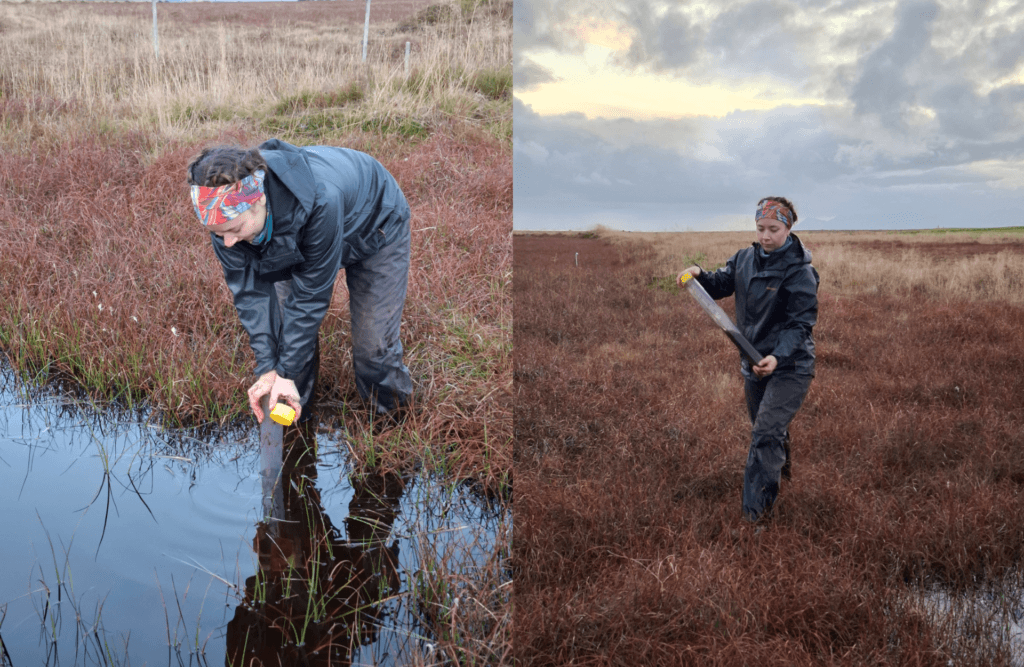
During the fieldwork in 2025, aquatic invertebrates were sampled from 3 pools and ponds from each site (a total of 75 waterbodies). The gathered invertebrates are currently being identified in the laboratory. In each sampling location, several characteristics of the waterbody and surrounding landscape were described.
The second fieldwork will take place in autumn 2026. 32 previously sampled waterbodies from 6 natural sites, 6 drained sites, and 4 restored sites (2 waterbodies per site) will be sampled again, based on the dust deposition gradient confirmed by soil analysis. The samples will be gathered by both sweep-netting, like in 2025, and by filtering eDNA from the water. Our aim is to confirm that year-to-year fluctuations in studied invertebrate communities are not major and that eDNA analysis gives similar, if not more detailed results compared to the sweep-netting method, and could therefore be used as an independent monitoring tool. The filtered eDNA will be sequenced by Novogene, UK. In data analysis, I will focus on the differences in invertebrate community composition and abundance across the dust gradient and in natural, drained, and restored wetlands.
A scientific paper will be submitted in autumn 2027. The results will also be discussed in Icelandic media, with the aim of having a positive effect on the public view of wetland restoration by adding a biodiversity point-of-view to the mostly carbon-focused discourse.